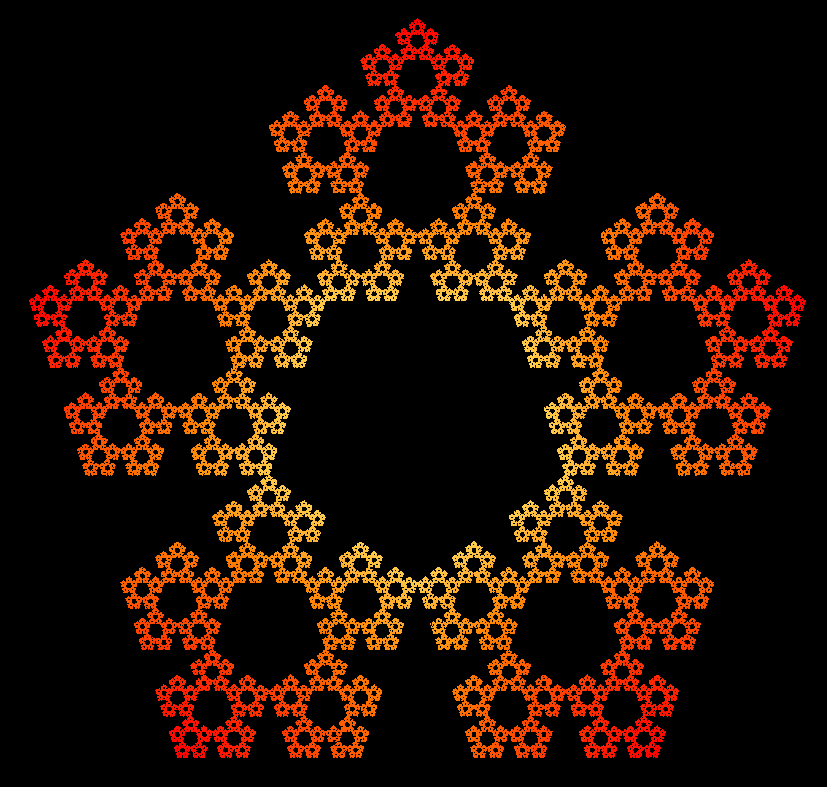

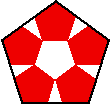
Now repeat these steps on the new set P(1). Here are the first three iterations.
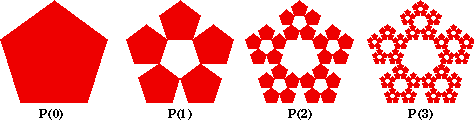
The Sierpinski pentagon is the limiting set for this construction.
\[\begin{align} {f_1}({\bf{x}}) &= \left[ {\begin{array}{*{20}{c}} {0.382} & 0 \\ 0 & {0.382} \\ \end{array}} \right]{\bf{x}} \\ {f_2}({\bf{x}}) &= \left[ {\begin{array}{*{20}{c}} {0.382} & 0 \\ 0 & {0.382} \\ \end{array}} \right]{\bf{x}} + \left[ {\begin{array}{*{20}{c}} {0.618} \\ 0 \\ \end{array}} \right] \\ {f_3}({\bf{x}}) &= \left[ {\begin{array}{*{20}{c}} {0.382} & 0 \\ 0 & {0.382} \\ \end{array}} \right]{\bf{x}} + \left[ {\begin{array}{*{20}{c}} {0.809} \\ {0.588} \\ \end{array}} \right] \\ {f_4}({\bf{x}}) &= \left[ {\begin{array}{*{20}{c}} {0.382} & 0 \\ 0 & {0.382} \\ \end{array}} \right]{\bf{x}} + \left[ {\begin{array}{*{20}{c}} {0.309} \\ {0.951} \\ \end{array}} \right] \\ {f_5}({\bf{x}}) &= \left[ {\begin{array}{*{20}{c}} {0.382} & 0 \\ 0 & {0.382} \\ \end{array}} \right]{\bf{x}} + \left[ {\begin{array}{*{20}{c}} { - 0.191} \\ {0.588} \\ \end{array}} \right] \\ \end{align}\]
The Sierpinski pentagon consists of five self-similar pieces corresponding to the five functions in the iterated function system.
\[\sum\limits_{k = 1}^5 {{r^d}} = 1 \quad \Rightarrow \quad d = \frac{{\log (1/5)}}{{\log (r)}} = \frac{{\log (5)}}{{\log \left(2/(3 - \sqrt 5 )\right)}} = 1.67228\]
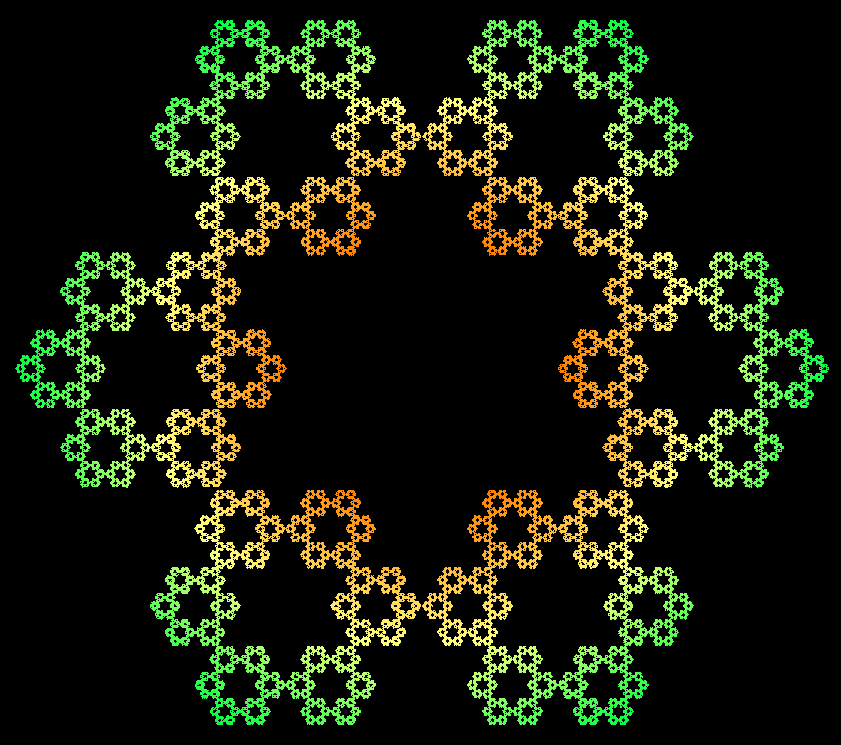
By changing the initial polygon and scale factor, it is possible to generate other types of fractals. The idea is to start with a regular n-sided polygon, then scale the polygon by a factor r so that n copies of the scaled polygon exactly fit inside the original polygon. The Sierpinski pentagon is such an example with n = 5 and r = 0.381966. The figure below shows the limit set for a hexagon as the initial polygon.
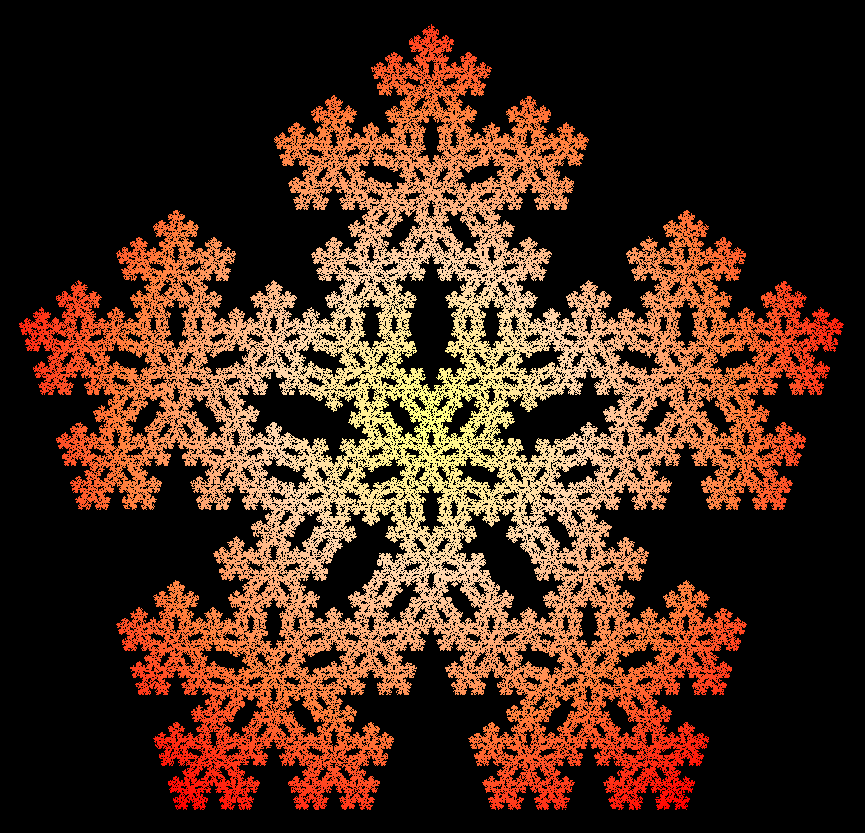
In 1525, the great Renaissance artist Albrecht Durer published The Painter's Manual in which he illustrated various ways for drawing geometric figures. One section is on "Tile Patterns Formed by Pentagons". Durer's description forms the basis for the attractor of an iterated function system.