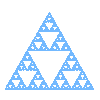
Suppose the area of the original triangle S(0) is equal to 1. At the first iteration we remove (1/4)th of the area of S(0), so S(1) has area 3/4. Next we remove 3 triangles, each having (1/4)th of the area of the triangle from which it is taken, so the total area we remove is 3/16. This means that S(2) has area 3/4−3/16 = 9/16 = (3/4)2. It looks like we should have that the area of S(n) is (3/4)n for all n. To see that this is indeed so, we can use induction. In constructing S(k+1), we remove 3k triangles, each of area (1/4)(k+1). Using our induction hypothesis, we get that the area of S(k+1) would therefore be
$${\rm{area }} \: S(k + 1) = {\rm{ area }} \: S(k) - \frac{{{3^k}}}{{{4^{k + 1}}}} = \frac{{{3^k}}}{{{4^k}}} - \frac{{{3^k}}}{{{4^{k + 1}}}} = \frac{{4 \cdot {3^k} - {3^k}}}{{{4^{k + 1}}}} = \frac{3 \cdot {3^k}}{4^{k+1}} = {\left( {\frac{3}{4}} \right)^{k + 1}}$$
So we were right about the formula for the area of S(n) for all n. Actually, there is a more direct way to see this. To get S(k+1), we scale S(k) by 1/2, which reduces the area by 1/4 = (1/2)2. But we make 3 copies of this scaled version to form S(k+1). Therefore the area of S(k+1) must be (3/4)th of the area of S(k). That's all we need to know to get our formula since this implies by repeated backward application that the area of S(n) is equal to (3/4)n of the area of S(0).
Notice that the area of S(n) goes to 0 as n goes to infinity. This means that we have removed "all" of the area of the original triangle in constructing the Sierpinski gasket. But of course there are many points still left in the gasket. That is one reason why area is not a useful dimension for this set.
Another way to compute the area of the Sierpinski gasket is to compute the area of the "holes" using self-similarity. Suppose that the triangle covering the gasket has area 1 (as we did with S(0) above.) Let \(A\) be the area of the "holes" in the gasket. Then \(A = \frac{1}{4}+3\left(\frac{1}{4}A\right)\), the area of the center "hole" plus the areas of the holes in the three copies of the gasket surrounding the center "hole", each of which is a 1/2-scaled version of the gasket so the area of those "holes" is scaled by 1/4.
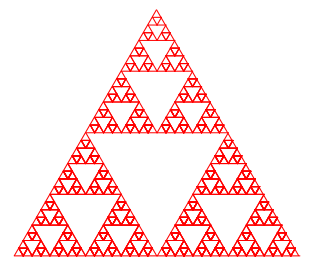
Then $$A = \frac{1}{4}+\frac{3}{4}A \Rightarrow \frac{1}{4}A = \frac{1}{4} \Rightarrow A = 1.$$ Thus the "holes" have the same area as the covering triangle, whence Sierpinski's gasket has area 0.