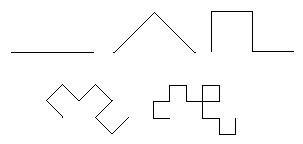
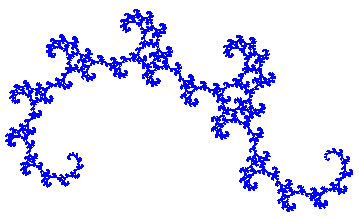
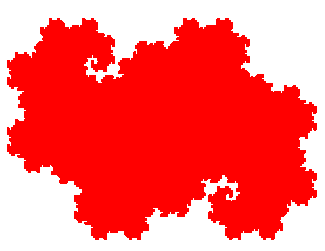
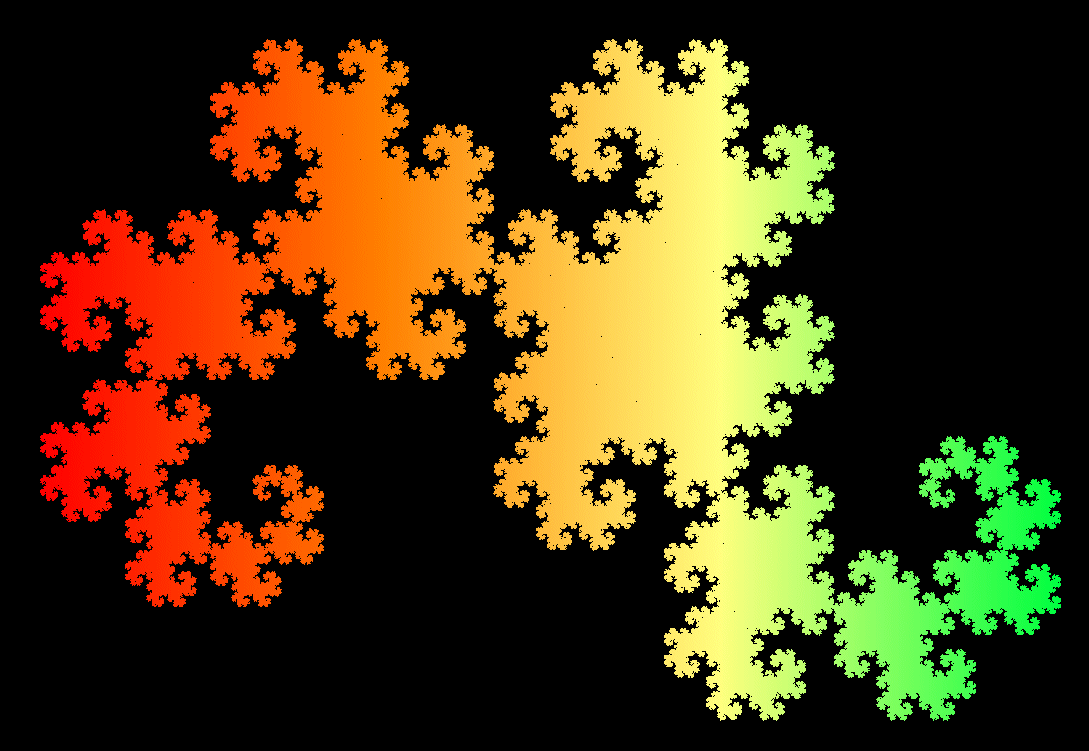
Begin with a line segment. As the first iteration, replace this
segment with two segments, each scaled by a ratio \({\bf{r}} = \frac{1}{{\sqrt 2 }}\) in such a way that
the original segment would have been the hypotenuse of an isosceles
right triangle. Following along the original segment, we place the
two new segments to the left. For the second iteration, replace each
of the segments with two new segments at right angles, each scaled by
the ratio r. The new segments are placed to the left then to
the right along the segments of the first iteration. Continue this
construction, always alternating the new segments between left and
right along the segments of the previous iteration. This generates
the "dragon curve". The following figure shows the first three
iterations for this construction.
Each iteration can be represented symbolically by a sequence consisting of the letters R and L. One can imagine moving along the individual segments making up the curve start at the left endpoint. A 90° corner is labeled R if the curve makes a right turn there, and is labeled L if the curve makes a left turn at that corner. So the three iterations shown above are represented by the sequences R, RRL, and RRLRRLL, respectively. [Details]
Construction via paper folds
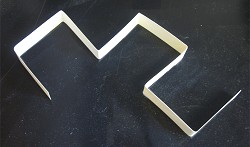
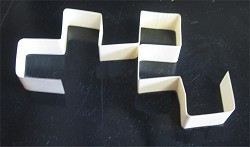
Here is how Heighway originally constructed the dragon. Fold a long narrow
sheet in half. Fold again in the same direction
(Example). Continue folding, always folding
in the same direction. After several folds, open the sheet so that
every fold is a right angle and view the sheet from the edge. In
general, n folds produces an order-n dragon. The
following pictures show an order-3 dragon (left) and order-4 dragon
(right) constructed from a narrow slice of a manila folder.
The same symbolic representation described above can be used to describe the sequence of folds. The order-4 dragon curve shown above is RRLRRLLRRRLLRLL. [More details]
Construction Animation
Construction via triangles
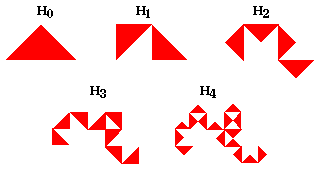
For yet another way to construct the Heighway dragon, start with an
isosceles right triangle H0. Replace this triangle with two isosceles
right triangles so that the hypotenuses of the new triangles lie on the
equal sides of the old triangle. Working around H0, starting from
the left side, we place the first new triangle so that it points out from
the old triangle and the other new triangle so that it points into the old
triangle to get H1. For the next step, repeat the process on each
of the triangles that make up H1, this time placing the new
triangles so they point Out, In, In, Out, respectively, as illustrated in
the figure below. This pattern of Out, In, In, Out is repeated for each
subsequent iteration of the construction.
The Heighway dragon is the limiting set of this iterative construction.
Notice that the line segments that make up the hypotenuses of the
triangles form the same path as described in the first construction above.
Iterated Function System
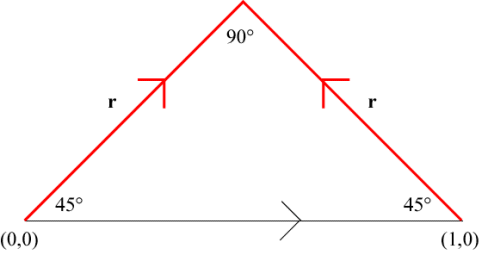
To think of this construction as a result of affine
transformations, consider the first iteration of the line segment
from (0,0) to (1,0) as shown by the two red line segments in the
following figure.
IFS Animation
Because of the need to alternate left and right when constructing
the dragon, we need to think of constructing the second line segment
by a rotation through 135° followed by a translation of the origin
to the point (1,0). This yields the following IFS
where \({\bf{r}} = \frac{1}{{\sqrt 2 }}\). The attractor
of this IFS will be the Heighway dragon. It consists of two self-similar pieces corresponding to the two functions in the IFS [Demonstration].
Angle 45
Axiom FX
F —> Z
X —> +FX−−FY+
Y —> −FX++FY−
First four iterations of the L-system
Similarity Dimension
The Heighway dragon is self-similar with 2 non-overlapping copies of itself, each scaled by the factor
r < 1. Therefore the similarity dimension, d, of the
attractor of the IFS is the solution to
The Heighway dragon was discovered by John Heighway in 1966 and named by William Harter. It was investigated by Heighway, Harter, and Bruce Banks while they were working as physicists with NASA. The dragon curve was described by Martin
Gardner in 1967 in his Mathematical Games column of Scientific
American where he stated that Harter used the dragon as a cover
design for a booklet prepared for a NASA seminar on group theory.
Many of its properties were first published by Chandler Davis and
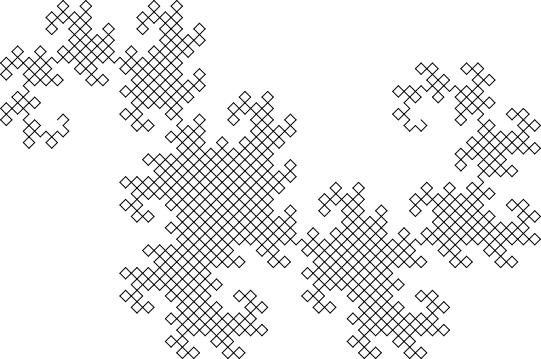
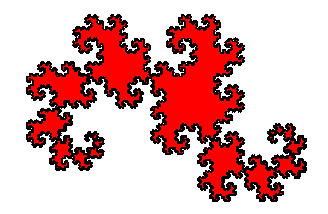
Donald Knuth in 1970. The version that Harter used for the NASA cover, and which was reproduced in Gardner's column, looked like the following (with 11 iterations, but the original had rounded corners.)
In his column Gardiner wrote that "the curve vaguely resembles a sea dragon paddling to the left with clawed feet, his curved snout and coiled tail just above an imaginary waterline." Donald Knuth reported in his book about how Harter remarked to him that the iterations of the dragon in Michael Crichton's novel, Jurassic Park, are upside down or "as dead dragons". The Heighway dragon now appears in many different orientations depending on how it is drawn [See Examples].
The Heighway dragon as described here starting with a line segment of length 1 has area 1/2 [Details]. If the initial line segment has length b, then the area of the Heighway dragon will be b2/2 [see the derivation of area based on the Heighway boundary].
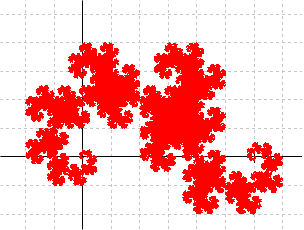
The copy of the Heighway dragon below lies on top of a grid of size 1/6 by 1/6 with it's tail located at the origin. It demonstrates that the Heighway dragon lies within a rectangle with –2/6 ≤ x ≤ 7/6 and –2/6 ≤ y ≤ 4/6, i.e. a rectangle of width 1.5 and height 1 [Details].
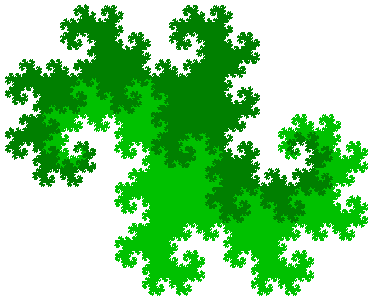
The Heighway dragon can be used to tile the plane [Details].
The boundary of the Heighway dragon is also a fractal with dimension 1.523627 [Details].
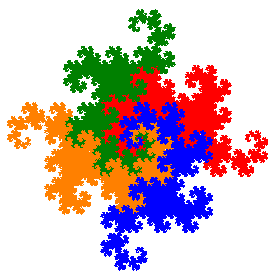
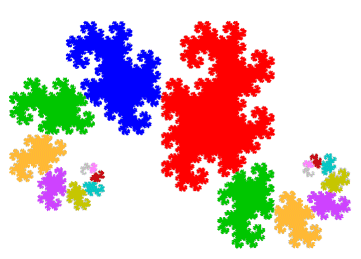
The Heighway dragon is composed of an infinite union of geometrically similar components that spiral around two curves ending at (0,0) and (1,0). Each component consists of four copies of the dragon (two twindragons), one copy of the component scaled by 1/2, and two copies of the component scaled by 1/4 [Details].
Let H be the attractor for the IFS. There is a
continuous curve f defined on [0,1] such that f([0,1])
= H and such that f is a space filling curve. This
means that H has a non-empty interior. For a proof, see the book by Edgar. [See Here for another example of a space filling curve generated by an iterated function system.]
Birth of a Heighway Dragon Animation
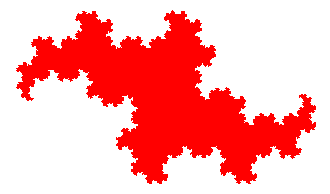
The Heighway dragon is constructed by replacing a line segment with two segments at 45°. If the angle between the line segments is less than 45° then a different dragon curve will be formed. If we let the angle grow from 0° to 45°, we can watch the Heighway dragon being born. See the animation.
The construction of the Lévy dragon
and the Heighway dragon are very similar. In each case one can start with
an isosceles right triangle and replace this triangle with two isosceles
right triangles so that the hypotenuse of each new triangle lies on one of
the equal sides of the old triangle. The difference is how those new
triangles are placed relative to sides of the old triangle. For the
Lévy dragon, both are placed towards the "outside"; for the Heighway
dragon, one is placed pointing out while the other is placed pointing in.
Because of this similarity, it is perhaps not surprising that one can
transform the Heighway dragon into the Lévy dragon through a
continuous transformation. Indeed, for each t in the interval [0,1] define
an iterated function system by
Let A(t) be the unique attractor of the iterated function system
corresponding to the value t. Then A is a continuous function from the
unit interval to the space of compact sets with the Hausdorff topology,
with A(0) equal to the Heighway dragon and A(1) equal to the Lévy dragon. The animation shows A(t) as t goes from 0 to
1.
The terdragon is a variation of the paper folding construction of the Heighway dragon in which the folds trisect the paper at each step instead of bisecting it. It was first introduced by Davis and Knuth in their 1970 paper on dragon curves.
The golden dragon is constructed similarly to the Heighway dragon construction via line segments, except using different scaling factors and angles. It has this name because its similarity dimension is the golden ratio.
If the elements of the Z2 cyclic group are applied to the functions in the Heighway dragon IFS, a new IFS is created whose attractor exhibits rotational symmetry through 180°.
References
Bannon, Thomas. "Fractals and Transformations," Mathematics
Teacher, March 1991, 178-185.
Budinski, Natalija and Miroslav Novta. "Folding the Dragon Curve Fractal," Proceedings of Bridges 2017: Mathematics, Art, Music, Architecture, Education, Culture, 573–578.
Crichton, Michael. Jurassic Park, Ballantine Books, New
York 1990. If you read the book or saw the movie, you will
remember that chaos theory, in particular the idea of sensitive
dependence on initial conditions, was a major reason why the
mathematician Ian Malcolm believed the idea of creating a
prehistoric world of dinosaurs would never work. Each chapter of
the book is illustrated with an iteration of the Heighway Dragon.
Davis, Chandler and Donald J. Knuth. "Number representations
and dragon curves" J. Recreational Math.3 (1970)
66-81 (Part 1), 133-149 (Part 2). Reprinted with extra addendum in Selected Papers on Fun and Games, Donald Knuth, CSLI Publications, 2011.
Gardner, Martin. "Mathematical Games," Scientific
American, March, April, July, 1967. [Reprinted in his Mathematical Magic Show, Knopf, 1977]
Jones, Juw. "Fractals Before Mandelbrot-A Selective History,"
in Fractals and Chaos, Crilly, Earnshaw, and Jones,
Editors, Springer-Verlag 1991.
Helmberg, Gilbert. Getting Acquainted with Fractals, de Gruyter Publishing, 2007. [See Preview at Google Books]
Lauwerier, Hans. Fractals, Princeton Science Library,
Princeton, N.J. 1991 (Translated by Sophia Gill-Hoffstadt from the
1987 edition), p.50.
Mandelbrot, Benoit. The Fractal Geometry of Nature,
W.H. Freeman and Co. 1983, p66.
McWorter Jr., William A. and Jane Morrill Tazelaar. "Creating
Fractals," Byte, August 1987, 123-132.
Prusinkiewicz, Przemyslaw and James Hanan. Lindenmayer
Systems, Fractals, and Plants, Lecture Notes in Biomathematics
#79, Springer-Verlag 1989.
Prusinkiewicz, Przemyslaw and Aristid Lindenmayer. The
Algorithmic Beauty of Plants, Springer-Verlag, 1990. [Available from the Algorithmic Botany website]
Ngai, Sze-Man and Nhu Nguyen. "The Heighway Dragon Revisited," Discrete and Computational Geometry, Vol. 29, no. 4 (2003), 603-623. [Available at Semantic Scholar or on ResearchGate].
Benedek, Agnes and Rafael Panzone.
"On some notable plane sets. II. Dragons",
Rev. Un. Mat. Argentina 39 (1994), no. 1-2, 76–89.
Ryde, Kevin. Iterations of the Dragon Curve, http://user42.tuxfamily.org/dragon/index.html. An extensive investigation of "Various properties of finite iterations of the Heighway/Harter dragon curve and twindragon curve, including boundary, area, convex hull, minimum rectangle, XY convex hull, centroid, inertia, complex base i±1, area tree, and some properties of the fractal limit including boundary and fixed point."