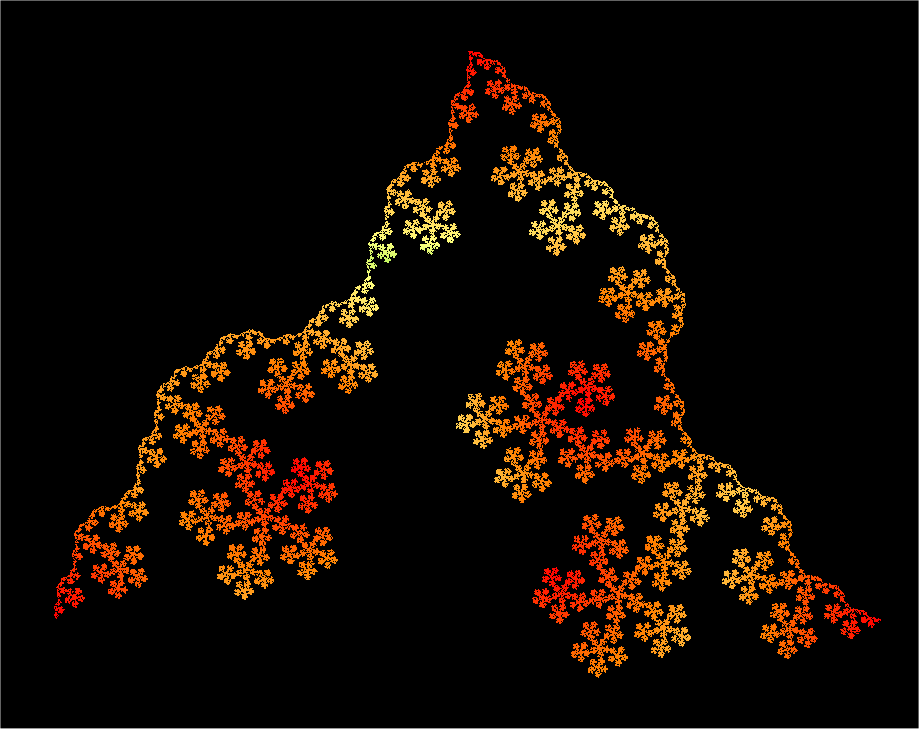

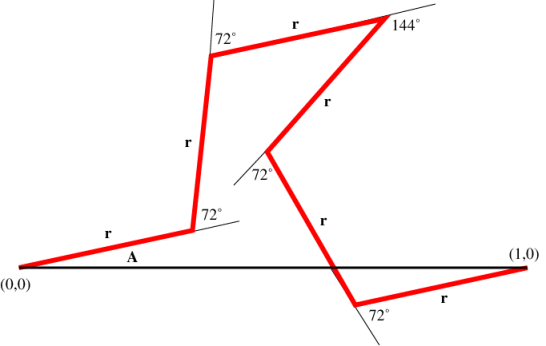
The six red line segments in the figure give the first iteration for this construction. The scaling factor r and the angle A must be chosen so that the endpoint of the last segment is at the point (1,0).
The following calculations show that \(r = \sqrt {\frac{{6 - \sqrt 5 }}{{31}}} = 0.34845\) and A = 11.81858573°.
|
\({f_1}({\bf{x}}) = \left[ {\begin{array}{*{20}{c}}
{0.341} & { - 0.071} \\
{0.071} & {0.341} \\
\end{array}} \right]{\bf{x}}\)
|
scale by r, rotate by A = 11.819° |
|
\({f_2}({\bf{x}}) = \left[ {\begin{array}{*{20}{c}}
{ 0.038} & { - 0.346} \\
{0.346} & { 0.038} \\
\end{array}} \right]{\bf{x}} + \left[ {\begin{array}{*{20}{c}}
{0.341} \\
{0.071} \\
\end{array}} \right]\)
|
scale by r, rotate by A+72° = 83.819° |
|
\({f_3}({\bf{x}}) = \left[ {\begin{array}{*{20}{c}}
{0.341} & {-0.071} \\
{ 0.071} & {0.341} \\
\end{array}} \right]{\bf{x}} + \left[ {\begin{array}{*{20}{c}}
{0.379} \\
{0.418} \\
\end{array}} \right]\)
|
scale by r, rotate by A = 11.819° |
|
\({f_4}({\bf{x}}) = \left[ {\begin{array}{*{20}{c}}
{ - 0.234} & {0.258} \\
{ - 0.258} & { - 0.234} \\
\end{array}} \right]{\bf{x}} + \left[ {\begin{array}{*{20}{c}}
{0.720} \\
{0.489} \\
\end{array}} \right]\)
|
scale by r, rotate by A−144° = −132.181° |
|
\({f_5}({\bf{x}}) = \left[ {\begin{array}{*{20}{c}}
{0.173} & {0.302} \\
{ - 0.302} & {0.173} \\
\end{array}} \right]{\bf{x}} + \left[ {\begin{array}{*{20}{c}}
{0.486} \\
{0.231} \\
\end{array}} \right]\)
|
scale by r, rotate by A−72° = −60.181 |
|
\({f_6}({\bf{x}}) = \left[ {\begin{array}{*{20}{c}}
{0.341} & { - 0.071} \\
{0.071} & {0.341} \\
\end{array}} \right]{\bf{x}} + \left[ {\begin{array}{*{20}{c}}
{0.659} \\
{ - 0.071} \\
\end{array}} \right]\)
|
scale by r, rotate by A = 11.819° |
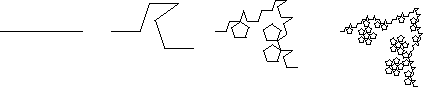
First three iterations of the L-system
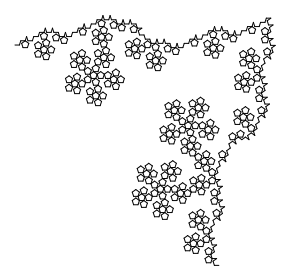
Four iterations
\[\sum\limits_{k = 1}^6 {{r^d}} = 1 \quad \Rightarrow \quad d = \frac{{\log (1/6)}}{{\log (r )}} = 1.6995\]